






British Columbia is practically built for off-grid RV camping.
From recreation sites tucked beside mountain lakes to remote camping areas far from traditional hookups, RVers across BC are increasingly looking for ways to spend more time away from serviced campgrounds.
The challenge is power.
How much solar do you actually need? Is one lithium battery enough? Can you run a coffee maker? What about a microwave? And will your solar panels still keep up when a classic BC cloud decides to park itself over your campsite for three days?
The good news is that an off-grid RV power system does not have to be complicated.
The best system starts with one simple question:
What do you actually want to run while you are camping?
Once you understand your daily energy use, it becomes much easier to choose the right combination of solar panels, batteries, inverter capacity, and charging technology.
Why Boondocking Is Booming
Off-grid capability continues to be a major focus in the 2026 RV market, with manufacturers and RV owners putting more attention on solar power, lithium batteries, larger energy-storage systems, and technology that allows travellers to stay away from hookups longer.
For RVers in British Columbia, the appeal is easy to understand.
Boondocking can mean quieter campsites, more flexibility, and access to places that feel completely different from a traditional RV park. Instead of planning every trip around a 30-amp or 50-amp pedestal, a properly equipped RV can use stored battery power and solar energy to support many of the comforts of home.
But there is an important distinction between having solar and having an RV that is truly equipped for your version of off-grid camping.
A small solar panel may be enough to help maintain a battery.
That does not necessarily mean it can support several days of lights, electronics, a furnace fan, an inverter, a coffee maker, and other electrical loads.
The goal is not simply to install the largest solar system that will fit on the roof. The goal is to build a balanced system where your solar generation, battery storage, inverter, charging equipment, and actual energy use all work together.
Calculating Your Solar Needs
The easiest way to understand RV solar is to stop thinking about panels first.
Start with your appliances.
Every electrical device uses a certain amount of power, measured in watts. The longer you run that device, the more energy it consumes.
The basic calculation is:
Watts × Hours Used = Watt-Hours
For example, a 50-watt device running for four hours uses approximately:
50W × 4 hours = 200Wh
Do that for the electrical devices you use during a typical day, add the totals together, and you have a rough daily energy budget.
Professional RV solar sizing guides follow the same basic principle: determine your actual energy use first, then size the solar array and battery storage around that demand.
What Do Common RV Appliances Actually Use?
Actual consumption varies significantly by appliance model, efficiency, operating cycle, battery voltage, and inverter losses, but these simplified estimates can help you understand the difference between light and heavy electrical loads.
| RV Device | Typical Power Draw | Example Daily Use |
|---|---|---|
| LED lights | 3–10W each | 30–100Wh |
| Phone charging | 5–20W | 10–30Wh |
| Laptop | 40–100W | 200–600Wh |
| Vent fan | 15–50W | 50–300Wh |
| Water pump | 40–100W | Usually low because it runs briefly |
| TV | 30–100W | 60–300Wh |
| Starlink equipment | Varies by hardware and conditions | Can become a significant daily load |
| Coffee maker | 800–1,500W | High power, usually short duration |
| Microwave | 1,000–1,500W+ | High power, usually short duration |
| Hair dryer | 1,200–1,800W | Very high power |
| RV air conditioner | Often 1,200W+ while operating | Extremely high daily energy demand |
The important distinction is between watts and watt-hours.
A coffee maker may draw 1,200 watts, but if it runs for only five minutes, its total energy consumption may be manageable.
A smaller device running all day can quietly consume much more energy.
That is why sizing an off-grid RV system based only on the biggest appliance can be misleading.
The Simple Solar Sizing Guide
For many RVers, the following ranges provide a useful starting point:
200 watts of solar:
Best suited to light electrical use and battery maintenance. Think lights, water pump, phone charging, and modest 12-volt use.
400 watts of solar:
A practical starting point for many weekend boondockers using lights, fans, electronics, and moderate daily power.
600 watts of solar:
Better suited to longer off-grid stays, heavier electronics use, remote work, or RVers who want more charging capacity.
800 watts or more:
Designed for higher-demand systems with larger lithium battery banks and more frequent inverter use.
These are starting points, not guarantees.
A 600-watt solar array does not produce 600 watts continuously throughout the day. Solar output changes with the season, sun angle, temperature, shading, panel orientation, and weather.
And in British Columbia, weather matters.
The BC Weather Factor: Why You Need a Buffer
A solar system that looks perfect on paper during a sunny Okanagan afternoon may behave very differently during several cloudy days on Vancouver Island or in a shaded mountain campsite.
Canadian off-grid system sizing needs to account for cloudy periods, snow cover, seasonal daylight, and periods when solar generation is limited.
This is where battery storage becomes just as important as the number of panels on your roof.
Think of it this way:
Solar panels refill the tank. Batteries are the tank.
A larger solar array can recharge your batteries faster when conditions are good.
A larger battery bank gives you more stored energy when conditions are not.
For BC camping, it can be smart to design around less-than-perfect solar conditions rather than assuming every day will deliver ideal sunshine.
If your RV uses approximately 1,500Wh per day, a theoretical system sized for exactly 1,500Wh of daily solar production leaves very little room for clouds, shading, conversion losses, or increased power use.
Building in additional solar capacity and battery reserve gives the system breathing room.
A Practical Example: The Typical BC Boondocker
Imagine two people camping off-grid who use:
- LED lighting
- Water pump
- Vent fans
- Phone charging
- Two laptops
- Television
- Moderate furnace fan use
- Occasional coffee maker or microwave use through an inverter
Their daily consumption might land somewhere around 1,500 to 2,500Wh, depending heavily on the season and how often high-draw appliances are used.
A practical system might include:
400–600W of solar + approximately 200Ah of lithium battery capacity for moderate use.
For longer stays, remote work, heavier inverter use, or more weather reserve:
600–1,000W of solar + approximately 300–500Ah of lithium capacity may be more appropriate.
Those numbers are not universal prescriptions. Roof space, RV electrical architecture, battery specifications, charging sources, and individual appliance use all matter.
But they provide something much more useful than saying, “Just add solar.”
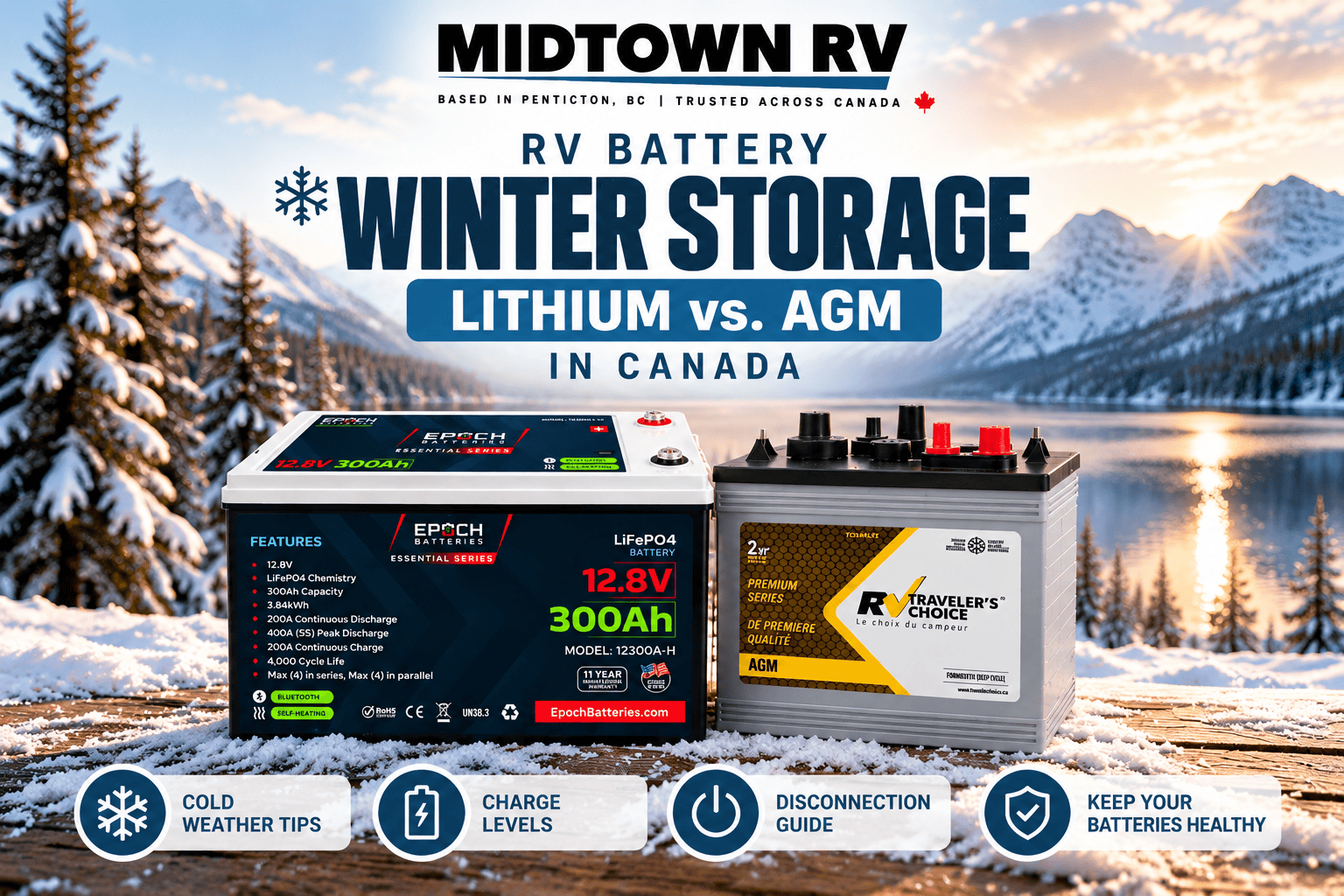
Lithium vs. Lead-Acid Batteries
Solar panels get most of the attention, but your batteries determine how much energy you can actually store for later.
Two RVs can both have a 200Ah battery bank and still have very different amounts of practical usable energy.
Lead-Acid Batteries
Traditional flooded lead-acid and AGM batteries have been used in RVs for decades.
They are widely understood and can have a lower initial purchase price.
However, lead-acid batteries are heavier and are generally operated more conservatively to protect battery life. A common planning guideline is to avoid routinely using much more than roughly half of the rated capacity.
That means a 200Ah lead-acid battery bank may be treated as having roughly:
100Ah of regularly usable capacity
Lithium Batteries
Lithium iron phosphate, commonly called LiFePO₄ or LFP, has become increasingly popular in RV applications.
Lithium batteries can generally provide significantly more usable capacity from the same nominal amp-hour rating, while also offering advantages in weight, charging performance, and voltage stability under load.
A 200Ah lithium battery bank can therefore provide substantially more usable stored energy than a similarly rated traditional lead-acid bank.
That difference becomes especially important for RVers who use an inverter.
A Simple Capacity Comparison
At approximately 12.8 volts:
100Ah lithium battery:
Approximately 1,280Wh of nominal stored energy
200Ah lithium battery:
Approximately 2,560Wh of nominal stored energy
300Ah lithium battery:
Approximately 3,840Wh of nominal stored energy
400Ah lithium battery:
Approximately 5,120Wh of nominal stored energy
The amount you can actually use depends on the battery manufacturer’s specifications, battery management system, temperature, system configuration, and recommended depth of discharge.
Is Lithium Always the Better Choice?
Not automatically.
Lithium can be an excellent upgrade for frequent boondockers, but converting an RV from lead-acid to lithium may involve more than swapping one battery for another.
Depending on the RV, you may need to evaluate:
- Converter or charger compatibility
- Solar charge controller settings
- Alternator charging
- Battery monitoring
- Cable size
- Fuses and circuit protection
- Battery location
- Cold-weather charging protection
This is particularly important in Canada.
Many LiFePO₄ batteries should not be charged below certain temperatures unless they include appropriate low-temperature protection or heating technology. Always follow the specifications for the exact battery being installed.
Upgrading Inverters and Tech
The battery stores the energy.
The inverter determines which household-style 120-volt appliances you can run from that stored battery power.
An inverter converts DC battery power into AC power for devices such as:
- Coffee makers
- Laptops and chargers
- Televisions
- Microwaves
- Small kitchen appliances
- Some residential-style RV equipment
What Size Inverter Do You Need?
A 1,000W inverter may be suitable for lighter electronics and smaller loads.
A 2,000W inverter is a common step up for RVers who want to operate higher-draw appliances.
A 3,000W inverter may support more demanding systems and larger simultaneous loads, provided the battery bank, cabling, fusing, and overall electrical system are designed to supply that power safely.
Here is the important part:
A bigger inverter does not create more energy.
Installing a 3,000-watt inverter on a tiny battery bank is a bit like installing a fire hose on a water bottle.
The inverter may be capable of supplying significant power, but the batteries still need enough capacity and discharge capability to support the load.
Don’t Forget Other Ways to Recharge
Solar is only one charging source.
A well-designed off-grid RV may be able to recharge through a combination of:
- Rooftop solar
- Portable solar panels
- Shore power
- Generator
- Vehicle alternator charging
- DC-to-DC charging
This can be especially valuable in BC.
If your campsite is heavily shaded or the weather turns cloudy, having another charging method can extend your trip without requiring an enormous solar array.
What Off-Grid RV Setup Is Right for You?
The easiest way to think about an off-grid RV upgrade is to choose your camping style first.
Light Weekend Camper
You mainly use lights, the water pump, phones, and basic 12-volt equipment.
Starting point:
200–400W solar
100–200Ah lithium battery capacity
Smaller inverter if 120V power is needed
Regular Boondocker
You camp off-grid for several days and use electronics, fans, television, laptops, and occasional higher-draw appliances.
Starting point:
400–600W solar
200–300Ah lithium battery capacity
Approximately 2,000W inverter depending on appliances
Remote Worker or Extended Off-Grid Traveller
You rely on laptops, internet equipment, multiple devices, and consistent power for longer stays.
Starting point:
600–1,000W solar
300–500Ah lithium battery capacity
2,000–3,000W inverter depending on loads
High-Power Off-Grid Setup
You want frequent use of large 120V appliances and a more residential electrical experience.
This requires a carefully designed system with substantial battery storage, charging capacity, and inverter capability.
At this level, system design becomes particularly important. Air conditioning, electric water heating, induction cooking, and other large loads can consume stored energy very quickly.
The Biggest Mistake: Sizing for a Perfect Sunny Day
When planning an RV solar panel installation in BC, the biggest mistake is assuming your solar panels will always operate under ideal conditions.
They will not.
Trees happen.
Clouds happen.
Shorter fall days happen.
And sometimes the most beautiful campsite is also the one with the worst solar exposure.
A better off-grid system is designed around your actual daily energy use, realistic Canadian weather conditions, and enough battery capacity to get through periods of limited solar production.
That may mean installing more battery storage.
It may mean adding portable panels so you can move them into the sun.
It may mean combining solar with alternator or generator charging.
The right answer depends on how and where you camp.
Planning Your Off-Grid RV Upgrade in BC
You do not need to become an electrical engineer to enjoy off-grid camping.
Start with four questions:
- What do I want to run?
- How many hours per day will I use it?
- How many days do I want to camp without hookups?
- What will recharge my batteries if the weather does not cooperate?
From there, an RV power system can be designed around your real camping habits instead of guesswork.
At Midtown RV in Penticton, BC, our team can help you explore RV solar panel installation, lithium battery upgrades, inverter systems, and off-grid RV upgrades based on your RV and the way you actually camp.
Because the goal is not to have the biggest battery bank in the campground.
The goal is to stay out long enough to forget where the nearest power pedestal is.
Planning an off-grid RV upgrade in British Columbia? Contact Midtown RV at 250-492-5705 to discuss solar, lithium batteries, inverter upgrades, and a power setup designed around your RV lifestyle.