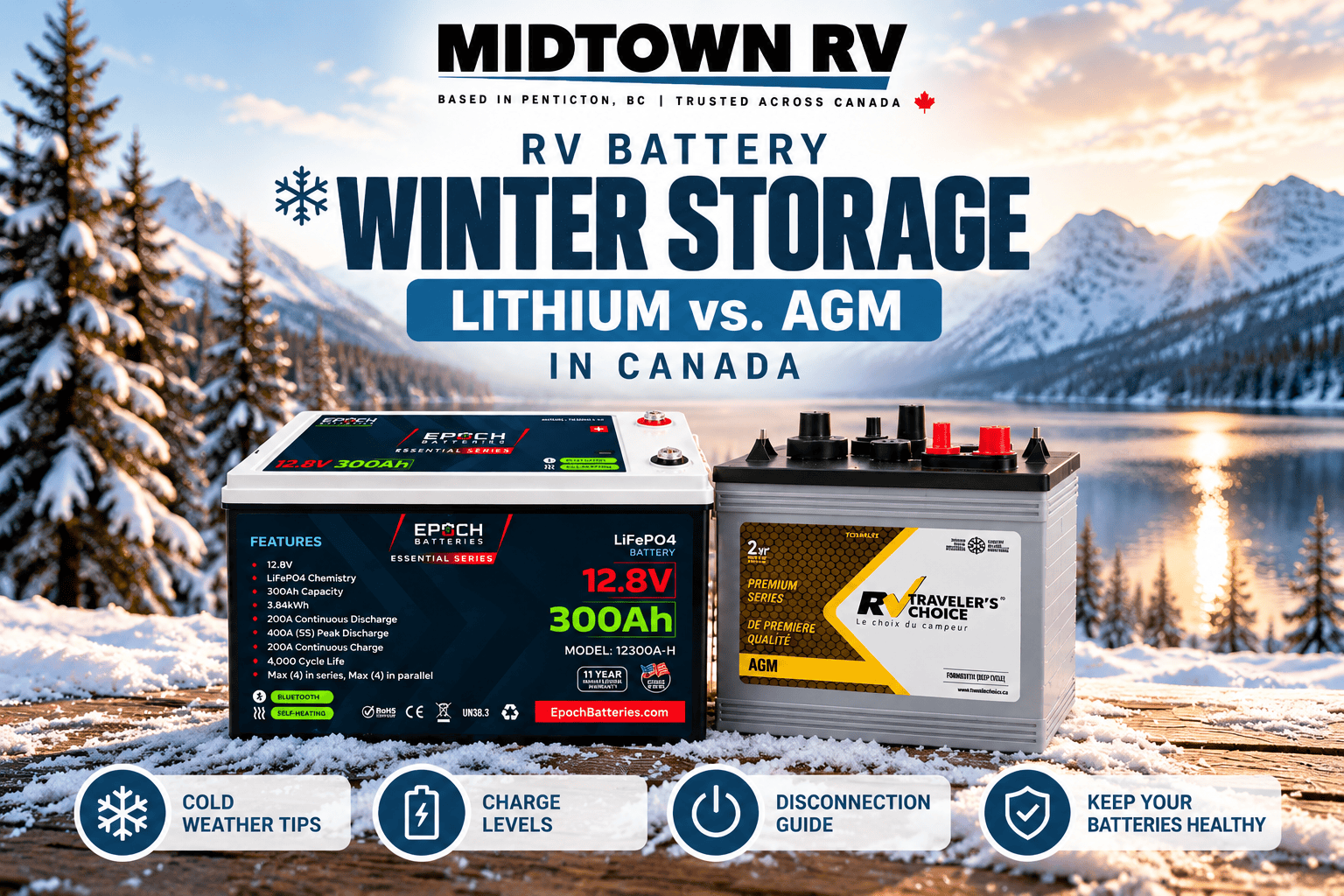






How to Store and Winterize RV Lithium (LiFePO4) & AGM Batteries in Canadian Climates
When the camping season winds down across British Columbia, one of the most important parts of winterizing your RV is often overlooked: the batteries.
Your RV’s battery system can sit quietly for months while temperatures drop, but that doesn’t mean it should simply be forgotten. AGM and lithium (LiFePO4) batteries have very different charging and storage requirements, particularly when Canadian temperatures dip below freezing.
The good news? Proper battery winterization is relatively simple once you know what type of battery you have.
At Midtown RV, we help RV owners understand the systems inside their coaches so they can head into winter storage with confidence.
AGM vs. Lithium: Why Does Winter Care Matter?
AGM and LiFePO4 batteries are both popular choices for RVs, but they behave differently in cold weather.
AGM batteries are a type of lead-acid battery. They have a relatively low self-discharge rate and can be stored in cold temperatures when properly charged. However, allowing an AGM battery to remain partially discharged for an extended period can contribute to sulfation and permanent capacity loss.
LiFePO4 batteries, commonly called lithium batteries, have extremely low self-discharge and can sit unused for long periods. Their major winter consideration is charging temperature. Charging a lithium battery when the cells are too cold can permanently damage the battery.
That’s where things get interesting.
The simple rule:
AGM: Keep it charged during storage.
LiFePO4: Keep it charged, disconnect unnecessary loads, and do not charge it when the battery is below its manufacturer’s minimum charging temperature.
Understanding the Freezing Point: Lithium vs. AGM
One of the biggest misconceptions about lithium batteries is that they simply cannot be used in cold weather.
That’s not quite right.
Lithium batteries can discharge in cold temperatures
Many LiFePO4 batteries can safely discharge below freezing. The problem is charging.
Charging a lithium battery when its cells are at or below freezing can cause lithium plating, which can permanently damage the cells. Different manufacturers and battery models have different low-temperature charging limits, so the battery manufacturer’s specifications should always take priority.
Some lithium batteries have a built-in Battery Management System, or BMS, that automatically stops charging when the battery becomes too cold. Some newer batteries also include built-in heating to bring the cells back into a safe charging range.
Important: Don’t assume your lithium battery has low-temperature protection just because it is lithium. Check the specifications for your particular battery.
What About AGM Batteries?
AGM batteries handle cold storage differently.
A fully charged AGM battery can generally be stored in sub-freezing temperatures, and cold temperatures actually slow the battery’s self-discharge. However, a partially discharged battery is more vulnerable to freezing and damage.
AGM batteries also gradually lose charge while sitting. Depending on the battery and storage temperature, manufacturers recommend periodically checking the battery and providing a boost charge when necessary.
This is why simply parking your RV and walking away for six months isn’t always the best plan.
Step-by-Step RV Battery Winter Storage Checklist
Before putting your RV away for the winter, take a few minutes to properly prepare the battery system.
1. Identify Your Battery Type
First, determine whether your RV has:
- AGM
- Flooded lead-acid
- LiFePO4 lithium
- A combination of battery types
If you’re not sure, check the battery label, owner’s manual, or have your RV service department identify it for you.
Don’t guess. Your charging system needs to be compatible with the battery chemistry.
2. Fully Charge the Batteries
Before storage, bring your batteries to the appropriate full state of charge using the correct charger or RV charging system.
For AGM batteries, starting storage with a full charge helps reduce the risk of sulfation and freezing-related damage.
For lithium batteries, manufacturers commonly recommend fully charging before long-term storage and then disconnecting the battery from loads and charging sources.
3. Turn Off Unnecessary Loads
Your RV may still draw a small amount of power even when everything appears to be switched off.
Examples include:
- Battery monitors
- Control boards
- Alarms
- Inverters
- Entertainment systems
- Other parasitic electrical loads
Over several months, those small draws can add up.
For long-term storage, follow your battery and RV manufacturer’s instructions for disconnecting the battery system.
Should You Leave an RV Plugged In All Winter?
This depends on the battery chemistry and the equipment installed in your RV.
For AGM batteries, an appropriate battery charger or maintainer designed for AGM and operated according to the manufacturer’s specifications can be used during storage. Temperature compensation may also be beneficial for lead-acid batteries.
For LiFePO4 batteries, continuous trickle charging is generally unnecessary. Lithium batteries have very low self-discharge, and manufacturers commonly recommend disconnecting them during long-term storage rather than continuously maintaining them with a conventional trickle charger.
The key is using a charger specifically designed and programmed for your battery chemistry.
One charger setting does not necessarily fit all batteries.
Don’t Forget About Solar
Solar panels can complicate winter storage.
Even when your RV is parked, the solar system may continue supplying power to the battery bank.
For AGM batteries, this can be useful when the system is correctly configured.
For lithium batteries stored in freezing conditions, however, you need to know whether your solar controller and BMS will prevent charging when the battery is too cold.
If your lithium battery is in an unheated compartment, this becomes particularly important.
A Quick Winter Battery Comparison
| AGM | LiFePO4 Lithium | |
|---|---|---|
| Cold-weather discharge | Reduced performance as temperatures fall | Generally capable of cold-weather discharge within manufacturer limits |
| Cold-weather charging | Possible with appropriate charging system | Do not charge below manufacturer’s minimum temperature |
| Self-discharge | Low | Very low |
| Winter maintenance | Periodic voltage checks may be required | Usually minimal when properly disconnected |
| BMS | No | Often included |
| Built-in low-temp protection | No | Depends on battery |
| Heated options | Not typical | Available on some models |
| Storage | Fully charged | Follow manufacturer’s storage SOC and disconnect guidance |
Specifications vary by battery manufacturer and model. Always follow the instructions for your specific battery.
Step-by-Step Battery Disconnection Safety Checklist
Before disconnecting anything, turn off shore power and other charging sources according to your RV and battery manufacturer’s procedures.
Then:
☐ Identify the battery chemistry
☐ Fully charge the batteries
☐ Turn off unnecessary DC loads
☐ Turn off the inverter if applicable
☐ Disconnect shore power as appropriate
☐ Disconnect solar charging if required
☐ Use the RV’s battery disconnect switch if equipped
☐ Inspect terminals and cables for corrosion or damage
☐ Check battery condition and voltage
☐ Confirm your charging system is programmed for the correct battery chemistry
☐ Follow the manufacturer’s storage instructions
☐ Check the battery periodically during extended storage if required
If you’re unsure which cable to disconnect or which charging source needs to be disabled, don’t guess. Battery systems can deliver significant current, and incorrect disconnection can damage equipment or create a safety hazard.
What About Lithium Batteries With Built-In Heating?
For RVers who camp or store their RV in genuinely cold environments, heated LiFePO4 batteries are another option.
These batteries use an internal heating system to bring the cells into an appropriate temperature range before charging. Some newer systems combine heating, a BMS and battery disconnect functions into the battery itself.
That can make lithium a practical choice for RV owners who want to use their coach during colder months.
But again, the exact specifications matter. Not every lithium battery is heated, and not every BMS has the same temperature thresholds.
What Should You Do in the Spring?
When you’re ready to bring your RV out of storage:
AGM
Check the battery voltage and condition, recharge as necessary, and inspect the connections before returning the RV to service.
Lithium
Check the battery condition and connections, reconnect the system according to the manufacturer’s instructions, and make sure the battery is warm enough to safely accept a charge.
If the battery has been stored in a cold environment, don’t immediately connect a charging source simply because the RV is plugged in. Verify the battery temperature and charging requirements first.
When Should You Have Your RV Battery System Checked?
If you’re unsure whether your RV is set up correctly for winter storage, a professional inspection can save you from discovering a battery problem when spring camping season arrives.
At Midtown RV, our service team can help with battery testing, electrical system checks, winter preparation and battery upgrades.
We can also help you determine whether your existing battery system is suitable for the way you use your RV.
For example, someone who primarily camps at serviced campgrounds may have very different battery requirements from someone spending several days off-grid in the Okanagan or Kootenays.
The Bottom Line
Winterizing your RV battery isn’t simply a matter of turning everything off and hoping for the best.
AGM and lithium batteries need different winter-care strategies.
For AGM, the priorities are keeping the battery properly charged, limiting self-discharge and checking it periodically.
For LiFePO4, the biggest cold-weather concern is charging temperature. A lithium battery may be able to discharge in freezing temperatures, but charging a cold battery can cause permanent damage unless the battery is specifically designed and protected for it.
A few minutes spent preparing your battery system before winter can mean one less unpleasant surprise when you’re ready to hit the road again.
Need help with your RV battery system? Midtown RV can help with battery testing, winter preparation, battery replacements and electrical upgrades.
Midtown RV
Based in Penticton, BC | Trusted Across Canada
Battery specifications, charging limits and storage procedures vary by manufacturer and model. Always consult your battery manufacturer’s documentation before winter storage or charging. When in doubt, have your RV battery system inspected by a qualified RV technician.