

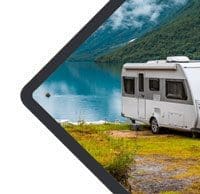


Fall RV travel in Western Canada can be spectacular. The roads are quieter, the scenery is changing colour, and there are plenty of great opportunities for one last trip before winter storage.
But fall also brings something RVers need to take seriously: rapidly changing mountain weather.
A sunny morning in Penticton can turn into snow, frost, rain or icy conditions by the time you reach a higher-elevation mountain pass. If you’re towing a travel trailer or fifth wheel, those conditions can make steep climbs, descents and tight corners considerably more demanding.
Before heading over the Coquihalla, Crowsnest Highway or other mountain routes in British Columbia, make sure your RV and tow vehicle are ready for the conditions.
Here’s what to know before you go.
Fall Mountain Driving in British Columbia
Mountain driving is different from towing on relatively flat highways.
You may encounter:
- Steep grades and long descents
- Sudden temperature changes
- Snow or ice at higher elevations
- Wet or slippery pavement
- Strong crosswinds
- Reduced visibility
- Construction or changing road conditions
- Increased braking demands
- Rapidly changing traction
The combination of a heavy tow vehicle and trailer means stopping, accelerating and controlling your speed requires more planning.
And one of the biggest mistakes RVers can make is waiting until they see snow before thinking about winter equipment.
In the mountains, the weather can change before the calendar says winter.
October Snow & Chain Requirements in British Columbia
For RVers, October 1 is an important date to have on your radar.
British Columbia requires winter tires or chains on most designated routes from October 1 through April 30. Some highways have different requirements or end dates, so always check the specific route you’re travelling. Requirements are posted with roadside regulatory signs.
The provincial government specifically identifies recreational vehicles in its winter tire and chain requirements. For RVs, the minimum requirement is generally M+S tires on the drive axle, although the province recommends carrying chains or another approved traction device when travelling in severe winter conditions.
What about fifth wheels and travel trailers?
If you’re towing a fifth wheel or travel trailer, BC recommends having the appropriate winter-rated or M+S tires on the drive axle of the tow vehicle and carrying chains for the trailer tires.
Why?
Because a trailer can begin to slide or push sideways on slippery, banked curves, particularly on mountain roads.
Don’t assume that because the highway is clear at the bottom of the mountain, the conditions will be the same at the summit.
The Coquihalla Highway
Highway 5, commonly known as the Coquihalla, is one of the most important mountain routes connecting BC’s Lower Mainland with the Interior.
The highway climbs to significant elevations, meaning weather can change quickly.
Snow isn’t unusual at higher elevations while lower elevations may still be experiencing rain or relatively mild temperatures.
Before towing the Coquihalla in fall:
- Check current highway conditions.
- Check the forecast for the entire route.
- Check conditions at higher elevations.
- Make sure your tires have adequate tread.
- Know where your chains are.
- Inspect your brakes.
- Check your trailer connection.
- Give yourself additional stopping distance.
- Be prepared to slow down.
BC’s official highway information identifies Highway 5 as a designated winter route, and winter tire/traction requirements apply beginning October 1 on designated sections.
Crowsnest Highway: Highway 3
Highway 3, the Crowsnest Route, crosses southern British Columbia through areas including Hope, Princeton, Osoyoos, Grand Forks, Castlegar, Creston, Cranbrook and Fernie before continuing toward Alberta.
For RVers travelling through the Southern Interior and Kootenays, fall conditions can change dramatically along this route.
A route that starts out dry and sunny can become wet, snowy or icy as elevation increases.
When towing, don’t simply focus on the weather where you’re leaving.
Check the conditions along the entire route.
Highway 97 and Other Interior Routes
Highway 97 runs through the Okanagan and continues north through much of the Interior of British Columbia.
For RVers leaving the Okanagan in fall, this can mean travelling through very different weather conditions in a single day.
You may leave Penticton in mild weather and encounter significantly colder conditions farther north or at higher elevations.
That makes your pre-trip inspection especially important.
Brake Controller Tuning Matters
One of the most important pieces of equipment when towing a trailer is the electric trailer brake system.
Your trailer brakes should work with your tow vehicle rather than relying solely on the tow vehicle’s brakes.
Before heading into the mountains, check that:
- The trailer brake controller is functioning properly.
- The trailer brakes are responding correctly.
- The trailer wiring connection is secure.
- The breakaway system is connected and functional.
- Brake components are in good condition.
- The trailer brakes are adjusted appropriately.
A brake controller that isn’t adjusted correctly can create problems.
If it’s set too aggressively, the trailer may jerk or lock up.
If it’s set too lightly, the tow vehicle may end up doing too much of the braking.
Mountain towing is not the time to discover that your trailer brakes need attention.
Managing Long Mountain Descents
Going downhill can be harder on your braking system than climbing.
When towing a heavy RV down a long grade, continuously riding the brakes can generate significant heat.
Instead:
Slow down before the descent.
Entering a steep downhill section at a controlled speed gives you more options.
Use the appropriate lower gear.
Allow the engine and transmission to help control your speed where appropriate for your vehicle.
Avoid riding the brakes.
Use controlled braking rather than keeping constant pressure on the pedal.
Leave extra following distance.
A heavy RV combination needs more room to stop, especially when roads are wet, icy or snowy.
Don’t let traffic dictate your speed.
Your safe speed may be lower than the posted maximum, particularly when towing in poor weather.
Transmission Care When Towing in the Mountains
Mountain towing puts additional demands on your tow vehicle’s drivetrain.
Long climbs can create additional heat, while repeated acceleration and deceleration can place additional stress on the transmission.
Before a major fall trip, consider having your tow vehicle inspected if you haven’t had it serviced recently.
A fall towing inspection can include:
- Transmission fluid condition
- Cooling system
- Engine oil and fluid levels
- Belts and hoses
- Brakes
- Suspension
- Steering components
- Tires
- Trailer connection
- Electrical connections
If your vehicle is working hard to pull a heavy trailer up a mountain pass, keeping temperatures under control matters.
Always follow your vehicle manufacturer’s recommendations regarding towing, transmission operation and use of lower gears.
Don’t Wait Until You’re on the Mountain to Learn Your Chains
If you carry chains, know how to install them before you need them.
Trying to figure out which chain goes where, in freezing temperatures, on the side of a mountain highway, is not the ideal time for a tutorial.
Before your trip:
- Take the chains out of their storage bag.
- Check for damaged links or components.
- Make sure they’re the correct size.
- Practice installing them.
- Know which tires they are designed for.
- Store them somewhere accessible.
And remember, chain requirements can depend on the vehicle, route and posted signs. Always follow the applicable roadside signs and current provincial requirements.
Check Before You Go
Mountain weather can change quickly, so your pre-trip routine shouldn’t end when you leave the driveway.
Before heading out, check:
Weather: Look at the forecast for your entire route.
Road conditions: Check current highway conditions and incidents.
Highway cameras: Look at conditions at higher elevations.
Winter restrictions: Confirm whether winter tires or traction devices are required on your route.
BC Government: Winter Tire & Chain Routes
BC Government: RV & Trailer Tire and Chain Requirements
Before Your Next Fall RV Trip, Let Midtown RV Check It Over
A fall mountain trip is much more enjoyable when you’re confident your RV and tow vehicle are ready for it.
At Midtown RV, our Parts and Service teams can help you prepare for the changing conditions that come with fall RV travel.
From brake inspections and suspension service to transmission-related maintenance and towing equipment, getting your RV checked before a major trip can help identify potential problems before they become roadside problems.
Our Parts department can also help with towing-related equipment such as:
- Weight-distribution hitches
- Brake controllers
- Trailer brake components
- Tire pressure monitoring systems (TPMS)
- Other towing and RV accessories
If you’re planning to cross the Coquihalla, Crowsnest Highway or another BC mountain route this fall, don’t wait for the first snowfall to start preparing.
Check your tires. Check your brakes. Check your hitch. Check the forecast. Know your route.
Then hit the road prepared.
Midtown RV
Midtown RV | Based in Penticton, BC | Trusted Across Canada
📍 310 Industrial Ave W, Penticton, BC
📞 250-492-5705
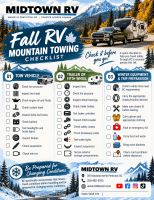
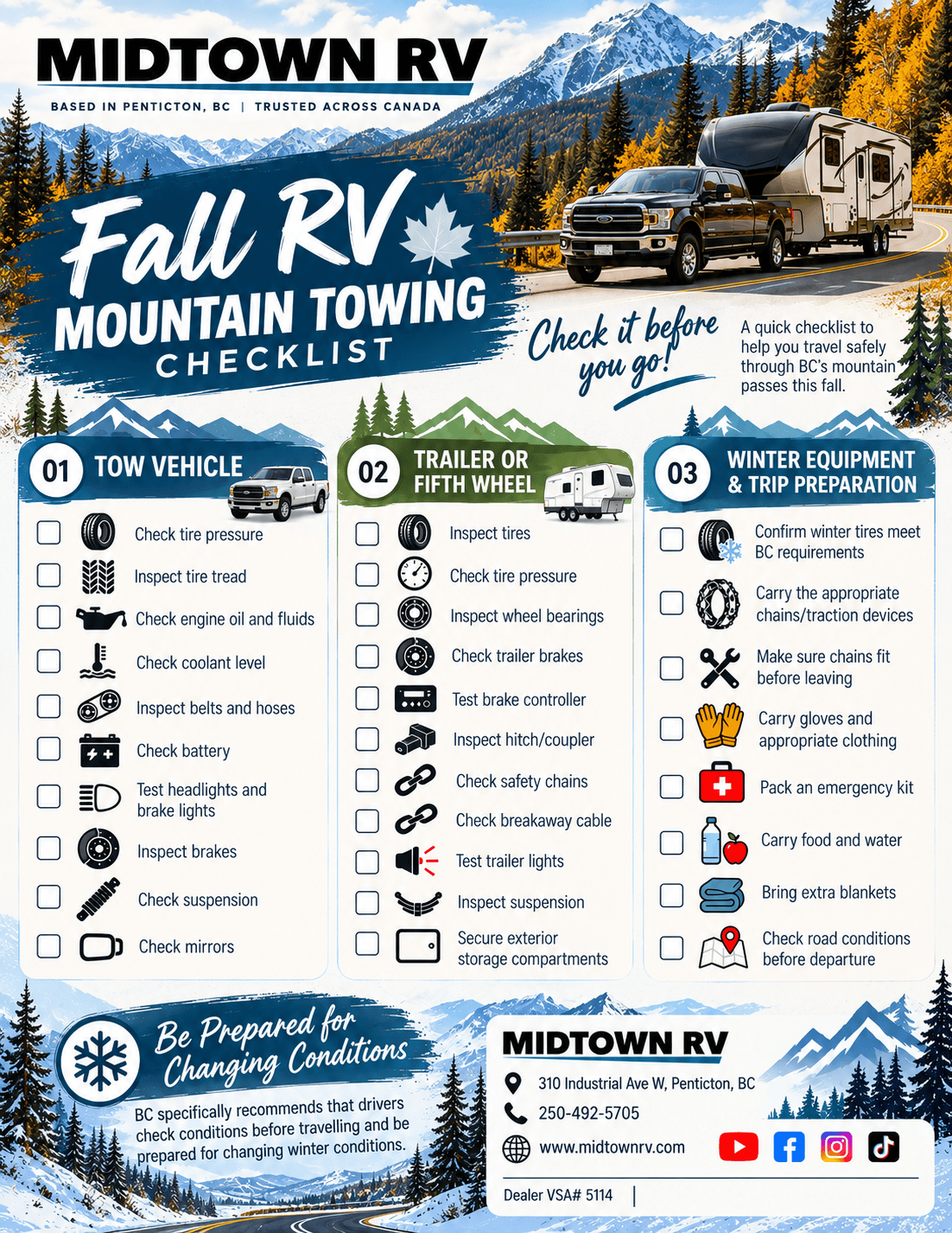
Download Your Fall RV Mountain Towing Checklist
Planning to tow your RV through BC’s mountain passes this fall?
We’ve put together a handy Fall RV Mountain Towing Checklist to help you prepare your tow vehicle, trailer or fifth wheel, and winter equipment before you hit the road.
Save it to your phone or print a copy to keep in your RV.
[⬇️ DOWNLOAD THE CHECKLIST]